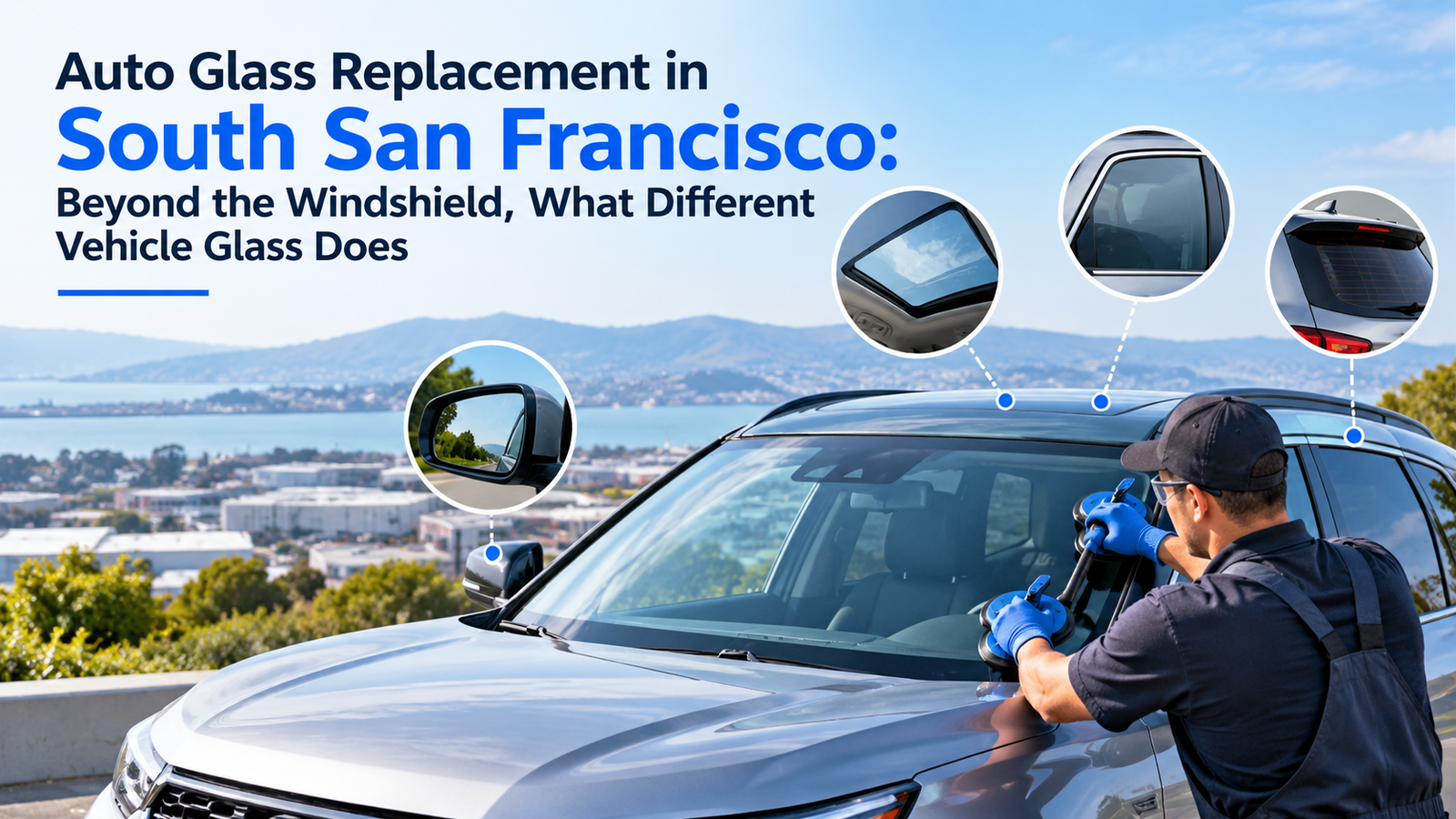
When people hear the words auto glass replacement, they usually picture a windshield. It is the largest piece of glass on a car and the one drivers look through all day. But a modern vehicle carries several kinds of glass, each designed for a different job, made from a different process, and replaced in a different way. Side windows, rear windows, quarter glass, sunroofs, and panoramic roofs all behave differently from the windshield, and they fail in different ways.
This article takes a broad look at Auto Glass Replacement South San Francisco as a topic. It explains the main types of vehicle glass, how they are manufactured and marked, why the differences matter when something breaks, and how each type is typically replaced. It also looks at local conditions in South San Francisco that influence the kinds of glass problems drivers encounter. It is written as general background, to help readers understand terminology and the reasoning behind how replacement works.
The Four Basic Roles of Vehicle Glass
Glass in a vehicle does several jobs at once.
Visibility. Drivers need to see clearly in all directions. Glass must be optically clean, free of distortion, and strong enough to resist the abrasion of wipers, weather, and road debris.
Protection. Glass blocks wind, rain, noise, and debris, and in many designs filters ultraviolet radiation.
Structure. The windshield and, to a lesser degree, other bonded glass contribute to the stiffness of the vehicle body and to occupant protection in a crash.
Integration. Modern glass carries heating elements, antennas, sensors, cameras, display layers, and tinted coatings. Replacement means matching those features.
Laminated Versus Tempered Glass
The most important distinction in auto glass is between laminated and tempered.
Laminated glass is made of two sheets of glass with a thin plastic interlayer, usually polyvinyl butyral, between them. The layers are heated and pressed together into a single unit. When laminated glass is hit hard enough to break, the plastic holds the pieces in place, and the glass cracks in a web pattern without falling apart. All windshields in the United States are laminated. A growing number of vehicles also use laminated glass in side windows for better noise reduction and security.
Tempered glass is a single sheet that has been heated and then cooled very rapidly, which creates compression on the surface and tension in the interior. That makes it much stronger than ordinary glass, but when it breaks the entire sheet fractures into small, blunt granules rather than sharp shards. Tempered glass is the traditional material for side and rear windows.
The two types behave very differently after damage. Laminated glass can often be repaired when the damage is small, because the plastic layer keeps the structure intact. Tempered glass cannot be repaired, because any breakage shatters the whole piece. Understanding this explains why some glass problems lead to repair and others always lead to replacement.
A Guide to the Main Glass Types
| Glass type | Typical construction | What it does | Common reasons for replacement |
|---|---|---|---|
| Windshield | Laminated | Structural support, airbag backing, visibility | Large cracks, edge damage, pitting, leaks |
| Front side windows | Tempered, sometimes laminated | Visibility, access, ventilation | Break-ins, object impact, failed regulators |
| Rear side and quarter glass | Tempered or laminated | Visibility, privacy tint | Break-ins, impact, seal failure |
| Rear window | Tempered, with heating grid | Rearward visibility, defrosting | Shattering, grid failure, impact |
| Sunroof and panoramic roof | Tempered or laminated | Light, ventilation, aesthetics | Shattering, seal damage, leaks |
| Mirror glass | Coated glass or reflective film | Rear visibility | Breakage, heating element failure |
The variety explains why replacement is not simply a matter of ordering glass in the right size. Each type requires a different process.
Reading the Markings on Auto Glass
Auto glass carries small markings, usually etched in a corner, that identify the manufacturer, the standards it meets, and sometimes the vehicle it was made for. These marks matter for replacement.
DOT code. A Department of Transportation number identifies the manufacturer.
AS ratings. Markings such as AS-1, AS-2, and AS-3 describe where the glass may be used and its light transmission. AS-1 glass is laminated and can be used anywhere, including windshields. AS-2 glass is used in locations other than windshields. AS-3 glass is privacy glass with lower light transmission and is not allowed in certain positions.
Safety standard references. Markings referencing the relevant safety standard confirm that the glass is made to meet federal requirements.
Manufacturer logos. Some glass carries the automaker’s logo, which indicates it was made to original equipment specifications.
When glass is replaced, the new piece should carry the appropriate markings for its position. Glass that does not meet the standards for its location is not suitable.
Why Glass Fails
Understanding failure modes helps explain why replacement is needed.
Impact. Stones, tools, thrown objects, and collisions break or crack glass.
Break-ins. Side and rear windows are the common targets of theft. Tempered glass shatters completely.
Thermal stress. Uneven heating and cooling cause cracks in laminated and tempered glass alike. A tempered window with a hidden edge flaw can break suddenly without an obvious cause.
Seal and adhesive failure. The urethane that bonds bonded glass to the vehicle can age, dry out, or be undermined by rust, leading to leaks, wind noise, or movement.
Mechanical failures. A side window may shatter or fall apart because of a failed regulator, a jammed track, or the glass itself.
Wear and surface damage. Fine scratches, pitting, and haze build up over years of exposure to grit and wipers and can make glass difficult to see through at night.
Defects. Occasionally a piece of glass has a manufacturing flaw, such as a stress point or a delaminating edge.
How Replacement Differs by Glass Type
The process varies depending on how the glass is attached and what it carries.
Windshield. The glass is bonded to the body with urethane adhesive. Replacement involves cutting the old bond, preparing the frame, applying new adhesive, and setting the glass accurately. Cameras and sensors may need to be transferred and recalibrated, and the vehicle needs time to cure before driving.
Bonded side and quarter glass. Some vehicles have fixed side glass bonded in place, in a similar manner to a windshield. These need adhesive, careful alignment, and cure time.
Door glass. Door windows slide in tracks and are held by clips attached to the regulator. Replacement involves removing the interior door panel and vapor barrier, clearing old glass fragments from the door cavity, installing the new glass on the regulator, and checking the movement. Fragments left in the door can interfere with the mechanism and cause rattles.
Rear windows. The rear window is typically bonded, and most carry a heating grid and an antenna. Connectors must be reconnected properly, and the grid must be inspected after installation.
Sunroofs and panoramic roofs. These are more complex. They may be mounted in a frame with drains, seals, and motors. Replacement requires care to maintain waterproofing and to avoid damaging the mechanism.
Mirror glass. The glass in a side mirror may be a snap-in piece, possibly with a heating element and a blind-spot indicator.
Features That Replacement Must Match
New glass has to carry everything the old glass did. Possible features include:
- A tinted or shaded band across the top of the windshield
- Acoustic laminate for noise reduction
- Solar or infrared-reflective coatings
- Heated elements for defrosting and wiper areas
- Mounting brackets for cameras, rain sensors, and mirrors
- A heads-up display layer
- Antennas and electrical contacts
- Privacy tint on rear glass
- Frit, the ceramic black band around the edge that protects the adhesive from sunlight
A mismatch can produce warning lights, poor sensor performance, or loss of a function. That is why the vehicle identification number, the options on the car, and the markings on the glass are all part of the replacement process.
Driver Assistance Systems and Their Role
Many modern vehicles have advanced driver assistance systems that rely on the windshield. Forward-facing cameras sit behind the glass near the rearview mirror. They support lane departure warning, automatic braking, adaptive cruise control, and other features. Some vehicles have additional sensors or lidar components near the glass.
When a windshield is replaced on such a vehicle, the camera’s position and aim can shift slightly. Calibration is the process of teaching the system its precise orientation. It can be done statically, with targets placed in front of the vehicle in a controlled space, or dynamically, by driving on suitable roads, or by a combination of both, depending on the manufacturer.
The calibration step has become one of the most discussed parts of windshield replacement, because skipping it can cause a system to misjudge distances or lane positions.
Adhesives and Cure Times
For bonded glass, the adhesive is as important as the glass. Auto glass urethane cures by reacting with moisture in the air. It must be applied to clean, correctly primed surfaces in a continuous bead. The cure time before the vehicle can be driven, known as the safe drive-away time, depends on the product, temperature, and humidity.
South San Francisco’s cool, humid conditions generally support moisture-curing adhesive, though very cold or very damp weather can change the timing. Technicians select products suited to the conditions and follow manufacturer instructions.
Door glass and some other pieces are not bonded and do not need adhesive cure, but they may involve sealing strips and clips that need to be set correctly.
South San Francisco Conditions That Shape Glass Issues
The city has features that influence the kinds of glass damage drivers see.
Wind and grit. Strong afternoon winds off the bay carry dust and sand, which pit and scratch glass over time.
Hills and uneven pavement. Steep streets and varied road surfaces flex vehicle bodies and add stress to bonded glass.
Busy freeway interchanges. Highway 101, Interstate 280, and Interstate 380 produce a steady supply of road debris, especially around truck routes and construction zones.
Airport and commercial traffic. Proximity to the airport brings a heavy volume of shuttles, delivery vans, and rental cars, which raises the odds of minor collisions and parking-lot incidents.
Street and lot parking. In dense neighborhoods and commercial areas, vehicles sit on streets and in lots overnight. Smash-and-grab break-ins are a known problem in urban areas across the Bay Area, and side and rear windows are the typical targets.
Fog and cool temperatures. The marine layer brings moisture, which can affect adhesive curing, fogging, and seal performance.
Industrial surroundings. Dust and fine particles from industrial and construction activity add to surface wear on glass.
Recycling and the Environment
Used automotive glass is difficult to recycle because laminated glass contains plastic. Tempered glass is somewhat easier to handle, but it is often contaminated with other materials. Some facilities separate the glass from the plastic and reuse the glass in products like insulation, fiberglass, and aggregate. Others send it to landfill. Recycling practices vary by region, and the growth in specialized processing is gradually improving the picture.
Repairing a chip or short crack rather than replacing an entire windshield avoids creating this waste in the first place, which is one reason repair is encouraged when it is feasible.
Common Misunderstandings
“All auto glass is the same.” Laminated and tempered glass have different structures, behaviors, and replacement processes.
“Any broken glass can be repaired.” Only laminated glass with small, clean damage is a candidate for repair. Tempered glass shatters entirely.
“The glass is the only thing that gets replaced.” Features like sensors, brackets, trim, seals, and heating elements may be involved.
“A windshield can be driven on right away.” Bonded glass needs time for the adhesive to cure.
“The dashboard will warn me if calibration is needed.” Not always. Calibration may be required even when no warning light appears.
“Side window replacement is just swapping glass.” Door glass work involves cleaning out shattered fragments and checking the regulator and tracks.
Frequently Asked Questions
What is the difference between laminated and tempered glass?
Laminated glass has a plastic layer between two sheets of glass and holds together when cracked. Tempered glass is a single heat-treated sheet that breaks into small granules.
Why can a windshield be repaired but a side window cannot?
A windshield’s plastic interlayer keeps the glass intact when it chips, allowing resin repair. Tempered side windows shatter completely when damaged, so there is nothing to repair.
What do the markings on car glass mean?
They identify the manufacturer and the safety standards the glass meets. Codes like AS-1 and AS-2 indicate where the glass may be used.
What is ADAS calibration?
It is the process of adjusting driver assistance cameras and sensors so they are correctly aimed after a windshield is replaced or the system is disturbed.
What is safe drive-away time?
It is the minimum waiting period after glass bonded with urethane adhesive is installed, before the vehicle can be driven safely. It depends on the adhesive, temperature, and humidity.
Why is rear window replacement more complex than it looks?
Rear glass often has a heating grid and antenna that need to be reconnected correctly, and the glass is usually bonded in place.
What happens to the glass in the door after a side window breaks?
Fragments fall into the door cavity and need to be cleared. Left inside, they can jam the regulator, scratch new glass, and cause rattles.
Does South San Francisco’s weather affect glass replacement?
Cool, damp air and wind can influence adhesive curing and the cleanliness of the bonding surface. Technicians plan around these conditions.
Final Thoughts
Vehicle glass is a family of components, not a single part. Windshields, side windows, rear glass, and roof panels are each built differently and play different roles in safety, comfort, and function. Understanding the difference between laminated and tempered glass, the meaning of markings and standards, and the reasons for sensor calibration and adhesive cure times makes the world of replacement much less mysterious.
For readers exploring auto glass replacement in South San Francisco, the local environment of wind, fog, hills, and busy corridors helps explain why glass issues arise and why the details of replacement matter. Knowing what each type of glass does, how it fails, and what a proper replacement involves gives drivers a clear framework for making sense of the work.